*READ ABOUT THE COURT CASE BEHIND THE WRIGHT HOUSE STORY

Just click the above link

Click the above "Court Case" link line to see a new special page added to this site...dating back to Fairport settlement days in the mid 1800s.

The Wright House on Sydenham Street

YOURS FOR THE CLICKING

OTHER DRESDEN RELATED BLOG SITES: YOURS FOR THE CLICKING
*DRESDEN: A PERSPECTIVE ON RACIAL DISCRIMINATION IN MY HOME TOWN

*THE WRIGHT STORY": IN THE BEGINNING THERE WAS HENRY AND MARY WRIGHT

*WRIGHTS LANE

*THE GAME I GREW UP WITH

*DRESDEN JUVENILES ONTARIO CHAMPS 1953

*THE PERRYS: MY OTHER HALF

*TRIBUTE TO DOC RUTTLE

Tuesday, May 20, 2014

FATHER AND SON...


This list of names in Ken Wright's printing (complete with spelling errors) was found in his well-worn Bible shortly after his death in 1952. The names were of young people who were members of his senior Sunday School class at St. Andrew's Presbyterian Church, 1950-51. 
Dresden Public/High School, circa 1940's.

High School Cadets doing an "eyes right" during inspection on old school grounds in 1949.
Cadet Officers Bob Peters (left) and Dick Wright, 1952.

DRESDEN HIGH SCHOOL FACULTY 1949-'50


A VISIT TO THE SCHOOL SYSTEM OF YESTERYEAR

I have been involved in research recently that has impressed upon me just how much our education system has changed in the past 100 years. No question that the school that my parents attended at the turn of the 20th century was not as much fun and as exciting as the schools enjoyed by their great grandchildren in the 21st century.

You only have to look at vintage news reels to see that our parents' and grandparents' generations suffered a tawdry, monochromatic education, dismally devoid of colour and imagination. It is not too surprising that many students dropped out before ever making it to high school. Of course, apprenticeships were readily available in many vocations in those days and economics were also a factor...Out of necessity, young people (boys in particular) were required to start making a living for themselves as soon as they were physically able. School start times were also adjusted to accommodate farm kids who were required to work in the fall harvest.

Punishment and discipline were high on the agenda too. Not learning math or neglecting homework often resulted in teachers administering the strap for insubordination. If work was not up to standard, students were actually failed and held back a year...Just ask me! I failed a grade when my father passed away during my first year in high school...An embarrassing and belittling experience that haunts me to this day, forever carrying the stigma of the "dummy" label. There was a certain regimentation too and the old school in Dresden (see photo above) that both my parents and I attended was no exception.

Extra curricular activities were virtually non existent. The biggest "social" event of the school year was the annual commencement exercises. An activity highlight was "track and field day" held in October of each year.

During elementary years, boys were assigned to one side of the school yard, and girls the other. Heaven help anyone who ever strayed beyond that invisible dividing line. Students also had separate entrances at the back of the school. Upon graduation (moving up) to high school on the second storey, boys and girls were privileged to use the same front entrance to the school as a first exposure to co-ed, co-existence in the society that awaited them. For most kids, it was a rite of passage -- an "I have finally arrived" sort of thing. Teachers, of course, had their own private entrance.

Children in my old hometown spent a good 12 years going to the same continuation school with primary grades on the first floor and senior grades (high school) on the second. This may account for why so many of us have a special feeling for our old schools. Kind of like our second home, in a way. We spent almost half of the first years of our life walking those familiar halls of learning. A place where our minds and personalities were formed, for better or worse. By my rough calculations, I figure that I and my dad each walked 7,200 miles over the Sydneham River Bridge, to and from the same school in our formative years.

It is interesting too that there is a good possibilty that at some point in time I actually sat in the same desk as my mom and dad during their days at school some 35-40 years earlier. The photo above shows school desks that were common in the first 40 years of the 20th century. They were bolted to the floor, so there was no moving them around. Note the intricate iron frames and oak wood seats, backs and desk tops with ink-well holes for ink bottles. Stock pens with replaceable nibs and fountain pens were the allowed writing tool of the day....No such thing as today's ball-point pens which came on the market only in the mid 1940s. Penmanship was actually a mandatory course on the curriculum.


When my mother and father went to school (1905-1915-'16) paper was at a premium and not readily available. "Scribblers", when available, were reserved for higher grades. Each child actually had their own slate board to write on and to do arithmetic calculations.

Slates and slate pencils were very handy (see photo to the right) in the early grades in particular. Children were able to write on the boards, show their work to the teacher, and make corrections without wasting paper. You could just wipe old work off your slate with a cloth, hand or shirt sleeve, and start all over again; hence the expression: "starting with a clean slate", so often used in conversation today. Slate boards made it easy for teachers too. With old work erased, all they had to do was move on to another lesson. Not a bad idea then, or now too for that matter!

Just imagine how many trees could be spared today by re-introducing slate boards to the education system. Guess we won't hold our breath on that one...!

Remarkably, schools in the first half of the 20th century turned out many brilliant minds and top scholars, so don't get me wrong. There were redeeming features. There will be a few (like me) reading this post who were virtual products of that very system; so I choose my words carefully.


 DRESDEN PUBLIC SCHOOL TEACHERS 1951-52
Front: Mrs. Art Woolner, Principal Robert Shultz, Mrs. Walter Lawrence, Miss Mary Graham. Rear: Mrs. Wilfred Abrahams, Miss Peggy Grieves, David Bow, Mrs. Roy Gibson, Mrs. Everett Boylan.

Wednesday, May 14, 2014

REFLECTIONS OF DRESDEN: A VISIT WITH A HOMETOWN GIRL (SEE VIDEO)

This is one of my favorite newspaper clippings from the 1940s, published in the North Kent Leader as a flashback feature in 1982. I went to school with three of the Browning sons, Clarence Jr., Larry and Doug. When Clarence Sr. returned home from the war numerous other little Brownings were curiosly added to the family.
Garnet Eves Jewellery Store was a fixture in downtown Dresden for four decades.  Shown here behind the counter is owner Garnet Eves (right) and son Herb in about 1955. I purchased a wedding ring from Garnet in 1959. Garnet's wife Marjorie also worked in the store as did my aunt Hattie Sharpe on a part-time basis.

Click on the video icon below to view this mini-movie stroll down memory lane. *Full screen view is recommended.  Have computer speakers 'ON'


This video, "Reflections of Dresden, a Visit With a Hometown Girl", will serve as a rather unique introduction to the nostalgia included with this site. It is an edited version of a DVD that I originally produced as part of an hour-long memorial service presentation for the late Dorothy "Jeanne" (Elgie) Ellis, 1915-2011. While Jeanne married and moved away in the mid 1930's, she retained a strong attachment to her hometown and looked forward to frequent visits with family and friends. So strong was her love for Dresden that her family asked me to pay this special tribute to her at the memorial service and what better way than to take a stroll through the town that Jeanne knew so well in the 1920's and 30's, and to invite her spirit to come along with us. You will have to set aside about 18 minutes to view the complete video. 

OFF TO THE RACES AT THE FAIR...
In the 1950's former high school classmate Betty Shaw  led the post parades on her beautiful palomino as part of the pageantry of the annual Dresden Fair harness race program. Below: Teddy McFadden, 6, in the foreground supervises as Fred List helps harness the horse Stewart Volo, owned by the Howard Bros. of Chatham. Partially obscured behind the horse is his father "Jiggs" McFadden, a well-known trainer and sulky driver. This photo was taken during the 1955 Dresden Fair races. The bottom photo was taken at the finish line of one of the heats in an extensive fair race card. A packed grandstand is shown in the background along with several of the old livestock barns of the era.


Craven's Garage and Gas Station, circa 1930, owned by Clarence Craven.  That's son Andrew (Junior) standing at the pumps.  The business was taken over by the Webster brothers about 1950.  Thanks to John Craven (son of Jack and grandson of Clarence) for providing this rare photo from a family album.

The Dresden Dairy, better known as "the Creamery", owned by Francis Foster, was a downtown landmark for many years.  Above is a stopper from one of the glass bottles of milk, delivered door-to-door each morning by horse and wagon.


THE MOVIE SCENE IN DRESDEN

To my knowledge there are no existing photos of the Majestic Theatre after massive renovations, 1930-60, so I attempted to sketch one from memory (the vertical Majestic sign is a figment of my imagination). The Majestic ran two movie features each week with Saturday afternoon matinees. It was the centre piece for entertainment in the mid 1900's. The original theatre 1914/ '15, was quite different from the theatre many of us went to 1940-'60+. As a point of interest, Menzo Craig was married to the former Gladys Wetherald and his brother-in-law Murray Wetherald also worked in the theatre as a projectionist. Murray operated an electronics repair shop adjacent to the theatre for many years. In the early days of silent screen movies Menzo often played the piano to accompany the action. Several women in town -- Velma Craft, Mae Sharp and Jessie McVean -- also took their turn providing lively music on the keyboard as black and while images flickered on the screen.


Thanks to Norman Kimber this circa 1955-'60 photo of the Majestic Theatre recently came to light. The exposure was taken shortly after dusk. My artistic rendition was not far off, after all.

Wednesday, September 4, 2013

THE 1940's: A PERIOD OF RESILIANCY IN SMALL TOWNS ACROSS CANADA


Dresden Community Band, circa 1949
This is the Dresden band that I am most familiar with. From the left (front row) Glen Wicks, Walter Tricker, Gabe deBerghe, Henry deBerghe, Band Master Charlie Aiken, Art Levick, Emerson Hooper, Gord Hazzard, Jerry Grabec; (middle row) Irwin Ripley, Vernon Craig, Jack Mawley, Curly King; (back row) Roy Smale. Walter Holmes, Lloyd Watson, Alfred Tricker, Elmer French, Dick Brown, Clarence Breaton Jr., Victor Swaiton, Gordon Baverstock, Cecil Bedford and Keith Wells.


Baseball was THE GAME!

REPEAT ONTARIO JUNIOR BASEBALL CHAMPS

Not only did Dresden win the Ontario Baseball Association Junior "B" championship in 1939 but with a number of players from that team still in the lineup they captured the provincial crown again in 1941 by defeating Oakville 7-5 in the final game played at Jackson Park.  Posing for the camera following the big win were: left to right (seated) Fred Wicks batboy, Stan Wells coach, George Bedell, Jack Craven, Oliver Stewart, Doug Wells, Jack Bowers, Bob Campbell manager; (standing) Orville Quick coach, Doug Simpson, Harold Fox, Ed Harris, Elmer Pattison, Ron Simpson and Bill Campion.
Dresden Juniors continued to field winning teams 1945 to 1948. Here's a photo of the 1945 version. From the left, front row, Martin Smith, Maurice Smith, Fred Wicks, Cliff Johnson, Jack Hunter, Junior Brown Garnet Elgie (coach); back row, Bob Campbell (manager), Hugh McCorkle, Ross Boylan, Gerald Cook, Roy Holmes, John McDonald, Willis Lovell, Jack London (coach). The photo was taken in the Band Shell at Jackson Park. 


The Legionnaires Juveniles added to the town's Ontario championship laurels in 1953 by defeating Wellington in the final playoff series and bringing provincial honors for the first time to the then two-year-old Kinsmen's Park. Members of the team were (from the left), front row, Don Brooker assistant coach, Carl Shaw, Bruce Huff, Larry Browning, Clarke Wallace, Len Bedell manager/coach, Floyd McCorkle; standing, Tom Ruckle, Jim London, Dick Wright, Bob Peters, Dean McLaughlin, Bob Davis and Larry Ennett.

Here is a photo of the Dresden Seniors Baseball Team taken in 1948 following a Kent County League playoff game in Chatham. From the left (front row) unidentified, Junior Brown, Hugh McCorkle, George Bedell, Tommy Houston, Lloyd Elgie, Don Simpson; (back row) Walter McFadden Jr., manager Stan Wells, Norm Paddock, Gerald Wicks, unidentified, Roy Holmes, Claire Horley, Pliney Stonefish and Doug Gibson.


Remembrance Day at the cenotaph, 1956.

THE "MAKE DO" ERA
In this video I highlight my memories of growing up during World War Two.  Click the arrow on the TV screen to view the contents, about 17 minutes in duration.  Be sure your computer speakers are turned on.
~~~~~~~~~~~~~~~~~~~~~~~~~~~~~~~~~~~~~~~~
Following the Great Depression and well into the WW2 period it was not uncommon for hobos to pass through Dresden and there seemed to be something about our house at the foot of Sydenham Street that was an inviting place of call.  I am reminded of one late summer afternoon when a fellow (not unlike the one in this photo) knocked on our door and asked my mother if she could "spare a bite to eat".  Since supper was on the stove, she invited him to have a seat in the shade of our front porch while she prepared a plate of roast beef, mashed potatoes and a cob of corn from our garden complimented by a tall glass of ice tea.  She even brought him a slice of lemon pie once he had polished off the plate.  As he was leaving following the repast, he leaned into our screen door to say: "Thank you madam...I feel just as good now as if I'd had a full-course meal!" That perhaps unintentional left-handed compliment, ever after became a joking family expression following all customarily sumptuous meals prepared by my mother and aunts.


HOME, SWEET HOME


BEFORE:  The Wright homestead on Sydenham Street (built in the 1870's) was looking pretty dingy in this 1920 photo before my parents undertook renovations some 15 years later.


AFTER: Looking pretty spiffy with new front porch, new roof and extensive interior upgrades.

Old homes fascinate me. I mean real old homes.


If only old homes could talk, what ghostly stories they could tell!

Furthermore there is nothing like an old home you once lived in to bring back memories -- happy, sad and in between. Lives once lived. A place where dreams were formulated. A comforting shelter from an at times harsh outside world.

I was literally raised in two old heritage homes in Dresden, ON. One was handed down to us (my mom and dad) by my grandparents Wesley and Louise Wright and the other a few blocks away owned by a very close and dearly-loved aunt, Hattie Sharpe.

"The Wright home" on Sydenham Street poses a bit of a mystery because of conflicting information. I was always led to believe that the red brick structure (one of the oldest in Dresden) was built by my grandfather in the late 1870s but there is another theory that it may have been built by William Wright (no relation), one of the town's founding fathers, before Wes and his second wife Annie moved into it. Complicating matters even further is the fact that Annie, a very young widow, was first married to another Wright who I have yet to definitively identify in any of my rather extensive family research.

Designated Heritage home in Dresden,
formerly owned by my aunt and uncle
Harold and Hattie Sharpe
Sufficient is this aspect of the home's history that I am determined to get to the bottom of it once and for all, hopefully with a visit to the Chatham-Kent Land Registry Office this spring. In retrospect, I should have closed the information gap before I sold the property in 1996 after the death of my mother Grace; even going so far as to possibly having it declared as a "heritage" holding. The matter has bothered me ever since.

*For the definitive result of my exhaustive research of land records, you can click on the special Wright House Story page that has been added to this site...See the link just under the "Father and Son" masthead.

No such mystery, however, with my Aunt Hattie's house at 396 Hughes Street, literally my second home when growing up (see attached photo) in the 1940's and '50's.  Reputedly and remarkably, this house is the most travelled in Dresden and the oldest on Hughes Street.  It was originally constructed on nearby Metcalfe Street, moved to St. George Street in 1870 and positioned at its present location in 1900. The white frame structure was originally constructed for Martha Webster, widow of George Webster, who latter married Dr. T.R. McInnes. As it happened, McInnes became close friends with famed black settler Josiah Henson and the relationship inspired him to write a poem called "Hard Times Come Again No More". He also wrote a number of other pieces and became a nationally respected writer.

It is understood that the doctor used half of the house for his office and the other half for a residence. The four-bedroom, one bath home remained divided during the three decades the Sharpes lived in it, the one half being rented to the Harvey Baverstock family.

Harold and Hattie Sharpe lived previously on a farm on the banks of the Sydenham River (eventually purchased by Fred Steeper) and bought the Hughes Street property in 1930. Harold, co-owner of a hardware business, passed away suddenly in 1936, leaving Hattie alone to raise three children Jack, Jim and Norma, all becoming respected members of the community. 

The Georgian style residence has a number of features distinctive to Dresden homes. The transom over the front door and sidelights not visible in the accompanying photo (behind little Dickie) were good examples.

There are approximately 72 designated properties in the Chatham-Kent Municipal Heritage Register -- 17 in the historic Town of Dresden.

They say that home is where you hang your hat, but for me it is where a part of my heart remains -- with all those old familiar sounds, smells, surroundings, memories -- and yes, ghosts that refuse to talk to me. Never to return, because life is like that.


Grampa Nelson Perry at the wheel of his new Hupmobile, 1922.

My mother (right) in the above photo, 1917, on the steps of the relatively new Dresden Continuation School and me (below) on the same steps some 30 years later.

Dresden Continuation School students, 1930


Names for DCS students, 1930, photo

Dresden Continuation School, 1935-'36

Dresden Continuation School, 1947-'48

Dresden Public School, 1943-44, Grade 2 boys class, Eunice Kimmerly teacher.


Dresden Public School, Grades 4&5, 1946-'47, Mrs. Pearl French teacher.


Ethnic dancers parade past Duff Motor Sales, circa 1940.

St. Andrew's Presbyterian Church members dressed in period costumes to celebrate Canada's Centennial. From the left, Beulah Anderson, Stan Wells, Grace Wright and Rev.William Black.

NEW ERA OF EDUCATION IN DRESDEN


Catherine McVean was president of the Dresden Continuation School student council and editor-in-chief of the Hi-News publication for 1949-50, the school term before the opening of the Lambton Kent District High School in Dresden. Her Editorial in that particular edition of the Hi-News was well done and served as a perfect introduction for a new era of education in Dresden.


First commencement exercise at the new Lambton-Kent District High School in 1953, combining students from Florence, Thamesville and Dresden area.

Bob Peters, Janet Smith and Dick at district high school track and field meet in Chatham, 1953. Winning ribbons for their new Lambton Kent District High School. 


Lambton-Kent District High School, soccer tam, 1953-54.
L to R: (front row) Charles Cajka, Larry Gray, John Shurr, Larry David, Don Dickson; (second row) Sheldon Parking, Bob Peters, Gerald Martin, Ron P(?), Murray Scott; (back row) Dick Wright, Charles Jackson, Carl Shaw, Lee McCaughrin, Allan Pegg.


Laurie Wells, the original editor/publisher of The Dresden Times, stands at the front door of the newspaper on Queen Street (circa 1890) with his ever-present notepad and pencil at the ready.  The Times remained at this location for a good 70 years.


Like the old Maple tree, Dick stretched up too.


That's all folks!...It is my story complete with warts and wrinkles, good memories and bad. Life is kind of like that. 
Dresden today...Pretty as a picture!

JULY 11, 1939: HISTORIC NIGHT A SPECTACULAR METEORITE DROPPED ON A DRESDEN AREA FARM

My hometown of Dresden is noted for more than just Uncle Tom's Cabin, championship baseball and hockey teams, its popular raceway and casino -- and pretty girls.  It is the site of a spectacular meteorite drop some 72 years ago.  This will not come as news to most of my older Dresden readers, but it will be news for many other followers of Wrights Lane.

Information for this post comes from various news sources, including an article written by Howard Plotkin in The Journal of Astronomical Society of Canada.  Plotkin is a University of Western Ontario Professor of Philosophy with more than a passing interest in meteorites. He was the organizer of an exhaustive search in 2002 and 2003 which, after so many years, successfully rounded up previously unknown fragments of the Dresden "fire ball".  Here is the amazing story:
~~~~~~~~~~~~~~~~~~~~~~~~~~~~~

Luke Smith (right) and farmer friend Marshall McFadden admire the Dresden meteorite resting between then on a porch step.  Later that day, Smith persuaded the original finder, Dan Salomon, to sell him the space rock for a paltry $4.00.
A spectacular fireball roared across the sky in southwestern Ontario as dusk fell on the night of July 11, 1939 and was seen by thousands of persons there and in Michigan, Ohio, Wisconsin, and even as far away as Pennsylvania.  The fireball underwent three explosions, and ended up dropping a 40-kg (88.25 lbs.) meteorite in the sugar-beet field of Dan Solomon, about 10 km southwest of Dresden, as well as several small fragments in nearby fields.

The meteorite, known officially as the Dresden (ON) Meteorite was high in nickel and iron content with many other properties and classified as H6 Chondite.  It remains the second largest individual meteorite to ever fall in Ontario and the fourth largest from all of Canada.  Through an interesting route, it ended up at the University of Western Ontario (UWO) and was put on display in the Biology and Geology Building.

The first recovered fragment of the Dresden meteorite was a small piece reported to weigh about 1 lb (454 g) dug out of the ground by Bruce Cumming on his sugar-beet farm, about two km south of Solomon’s farm.  Cumming reported (Chatham Daily News, July 12, 1939) that he and his family were attracted outdoors when the entire countryside was lit up by the glare of the falling meteor. He reported hearing a roar "like thunder" when it seemed to pass directly overhead, then "a strange noise like the staccato firing of a machine gun, or the sputtering of an airplane engine," and then a "dull thud", as the meteorite hit the ground about 100 metres from his house.
This fragment of the Dresden
meteorite was found in a Grand
Bend flea market in 1993.
The family quickly formed a search party, and headed out in the direction the noise seemed to have come from. Their dog Shep accompanied them and led them directly to the spot where the meteorite had landed and buried itself to the level of the dirt and mashed one or two small sugar beets to a pulp.

The main mass of the meteorite landed in Solomon’s field, only 200 metres from where his wife Hazel was standing with their children.  Her description of the event clearly reveals how terrifying it was for her:  "My little girl, two years old, saw it first, coming out of the northern sky. I was weeding in my garden at the time.  When I first looked up it was about the size of a baseball.  It kept getting bigger and bigger until it was about the size of a bushel basket. I started to run toward the field at the back of the house. I was too scared to know what I was doing. When it got directly over me it stopped and made a noise just like a big rotten egg being broken -- a sort of hollow plop. The thing shot off toward the west. Just at the same instant or maybe a second afterward, I heard a terrible noise in the field right ahead of me. It sounded like a big airplane tearing along the field. That scared me worse than ever and I turned and ran back toward the house. My four children were with me. My husband returned from Dresden a few minutes later, but I wouldn’t let him go to the field until the following morning."
Dan Solomon up to his chest
in the meteorite hole.
On the morning of July 12, Dan Solomon set to work to retrieve the main mass of the meteorite. He found that it had made a hole 30 cm by 45 cm.  Dirt was piled up all around the hole and chunks of earth were thrown 13 metres away. He enlarged the hole and began digging.  At about two metres, the top of the meteorite became visible. His children looked on with fascination, as did a crowd of interested neighbours, including Charles "Chuck" Ross, then  a young editor of the Dresden News, who had raced to the scene. Ross helped Solomon hook a chain around the meteorite, and with neighbours’ help they were able to extricate it from its hole.

Later that day, Henry Lozon reported he had recovered a fragment weighing about 5 lbs (2270 g) 80 metres from his house, and it was rumoured that two other nearby neighbours, A.V. Scott and George Highgate, had also dug up fragments of the meteorite on their farms.  According to a report in the Globe and Mail ( July 13, 1939), they "were awaiting offers" for their specimens.

Solomon didn’t have long to wait for an offer for his 88.25-lb (40.07-kg) meteorite. Luke Smith, a former Chatham dentist turned oil and gas prospector,  and his friend Marshall McFadden, saw the meteorite as it was being cleaned and
quickly paid Solomon a visit. Smith decided (Toronto Daily Star, July 13, 1939) he wanted to purchase the meteorite: "I thought an oil man should not miss a chance to get that close to heaven.  Besides, it’s a nice relic." According to one story, he was told that someone had already offered Solomon $3.00 for the "souvenir", so he raised the ante to $4.00.
Beth Ross, sister of Dresden
n
ewspaper editor Charles Ross,
in the process of cleaning the
Solomon farm meteorite.
Solomon’s son Wilfred later said that Smith and McFadden pestered his dad incessantly to sell the meteorite. Solomon, by all accounts a very gentle, soft-spoken man, gave in to this pressure, and agreed to sell it to Smith for $4.00. But within a very short time, Solomon began to realize how terrible a deal he had made.  A desperate plea to retrieve the prized specimen from Smith was to no avail, however.

Many in the area at the time protested that Smith had taken unfair advantage of Soloman, but he held fast claiming that a deal is a deal and "the law of supply and demand held good, even for meteorites."  He subsequently refused a number of offers to purchase (including universities in the U.S. and the Smithsonian Institution) in the $200.00 range, holding out for his price of $800.00 to $1,000.00.

Newspaper accounts about the meteorite appeared daily.  So did hordes of motorists, some from as far away as Ohio, who lined the concession road in front of Solomon’s farm for days on end, eager to see the meteorite. Although they were disappointed to find out that it was no longer there, many helped themselves to small chips of the meteorite that had splattered off when it plowed into the ground, or had been rubbed off it by the chain used in its excavation. Wilfred Solomon remembers selling small chips to  passing motorists for a few pennies each.  Many of the tourists were from the U.S., prompting one newspaper (London Free Press, July 22, 1939) to wryly note: "...American tourists have gone home with a large number of fragments from the recent spectacular meteor. This addition to Canada's tourist income will never be known, probably."
~~~~~~~~~~~~~~~~~~~~~~~~~~
On the lighter side:  Dresden Virtual History Group contributor Frank Vink, recalls with humour that his father, whom he expected watched too many Flash Gordon movies, was sure that the meteorite was an invading "rocket from China".  His grandmother even got her rosary out, convinced that it was "the end".

"A piece (of the meteorite) landed in the field of a neighbor on the Prince Albert Side Road in the 13th Concession of Chatham Township.  When the neighbor retrieved the remnant, he put it into his flower garden," Frank adds.
~~~~~~~~~~~~~~~~~~~~~~~~~~ 

In early October, it was announced in the London Free Press, (Oct. 7, 1939) that the meteorite had "been purchased outright and now is in the possession of the University of Western Ontario."  Although the price was not given, the newspaper article read: "The purchase of the famous fireball was made possible through the kind offices of the directors of the London Life Insurance Company."

Through the efforts of Don Spanner, the London Life Archivist, UWO author Howard  Plotkin found out that its Board of Directors contributed $700.00 to the university to buy the meteorite from Smith. London Life's gift was motivated in large part by E.E. Reid, Managing Director, who was also a member of the University’s Board of Governors.  Reid stipulated he wanted the meteorite displayed in the new observatory soon to be erected on the campus, a gift from the estate of actor Hume Cronyn. In 1970 the meteorite was moved from the Observatory (a plaster cast of it remained there), and placed in a glass showcase outside the office of the Department of Geology.

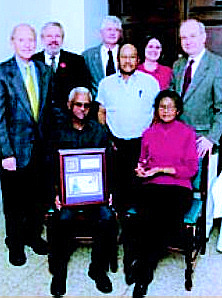
It was not until some 60 years later that members of the late Dan Solomon's family were honored by the University of Western Ontario for their father's historic discovery and the innocent, ill-advised deal that saw him give away the Dresden meteorite to the shrewd opportunist, Luke Smith.  (See photo)
Two sons and a daughter of the late Dan Solomon attended a tribute evening for their father, hosted by the University of Western Ontario. A fragment of the meteorite that landed on the Solomon farm in 1939 was presented to the family along with a plaque commemorating the occasion.