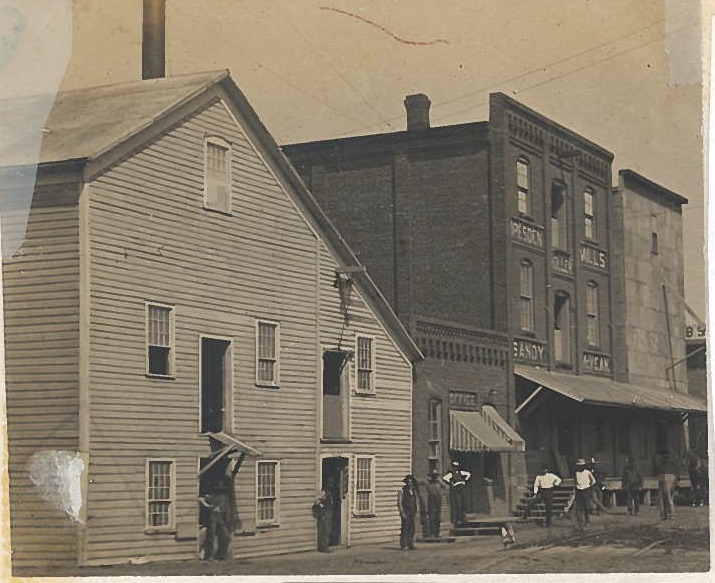
St. George Street on a "quiet" Sunday morning in the year 1910. There were no stores open on the Sabbath in those days. It would be business as usual on Monday morning, however.
-----
The following article was written by my father, Ken Wright, and published in The Chatham News, November, 1942. Ken was born in Dresden in 1899 and he was reflecting on the downtown Dresden that he remembered as an 11-year-old boy.
.May I take the liberty of trying to paint a word picture for you that may be at least just a little refreshing. Many readers may fail to catch the spirit or feel of such a thing, especially if they never had the good fortune to live at least a part of their life in a small town.
.
Dresden, back in the year 1910, was a typical small town and life ran pretty much true to form with towns of equal size everywhere. There was a blacksmith shop operated by a brawny Irish blacksmith who's anvil clanged musically on this particular July afternoon. The tinsmith over one of the hardware stores joined into the chorus as he hand-riveted a length of stove pipe.
.
Nearby was a printing press where type was set by hand -- thump, thump, thump, thump -- softly in rhythm with the anvil and riveter. Down the hot street a man in clean while ducks, white shirt and white shoes, worked his foot drill as he shaped a beautiful set of new choppers (dentures). And so on down the lazy, dusty, quiet street the town's respected gentry forced themselves to work in shops and offices this beautiful summer day.
.
Several horses drank deeply from the big trough at the town pump. A barber whose shop was just across the street, looked at his watch, tipped forward in his chair, got up slowly and sauntered off down the street. It was the hour of three in the afternoon.
.
As if by pre-arrangement, the blacksmith's anvil went silent as did the tin shop's riveter. The typesetter washed his hands and put on his straw hat. All business seemed to take on a hush as the men, all leisurely, walked to a given point on main street -- the old Wescott House -- for a turn-of-the-century version of today's "coffee break".
.
Those were different days. Automobiles were as scarce as hen's teeth. There were just two of them in town at the time. Men would scramble to the alert, tightening up on the lines as their team of horses reared, shied and lunged at the approach of these new, noisy chain-driven machines. The driver of the horses would scowl and mutter unprintable suggestions as he struggled to bring the terrified team under control.
.
Then there was the barber who "fixed" his new chain-drive job one day, only to discover that he had a cigar box full of nuts and bolts left over. "She still runs as good as ever," boasted the barber whose story became a part of Dresden folklore.
.
Those were the days when you could raise a hand when approaching a crosswalk and the driver of the car would, almost always, sputter to a stop.
.
Yes, the days before the First World War are pleasant to reflect on. Like when one went *out back, they always returned inadvertently with an arm full of wood for the benefit of the wood box and their next door neighbor.
---
Life was just a bit more rugged then, but cozy.
---
Cordially,
Ken Wright,
Dresden
-----
Follow up notes
* Out back meant going to the "outhouse", or outside toilet. Homes were heated with either wood or coal and all cooking was done on a wood stove, that's why it was so important to keep the wood box filled up. Wood was usually piled in front of the outhouse for privacy and to cut down on the wind on cold winter days.
.
When Ken was 10-years-of-age he secretly saved up his pennies until he had enough to buy a bathing suit from Nobel Law. Secretly, because his mother did not know he was swimming in the Sydenham River at such a young age. Each day after a swim he would hide the bathing suit under the board walk, about a block away from home. He got away with it for quite a few weeks too, that is until the day he came home with very wet hair -- and the gig was up.
-
Ken wrote periodic columns and letters to the editor, just for the love of writing. His wife Grace was a paid correspondent for both the Chatham News and Windsor Star. Writing, it would seem, is/was in the Wright genes.
-
Nelson Perry, father of Grace and grandfather to Dick, ran a general store in Dresden (see above photo) for a number of years after selling Perrys Bakery to Peter Burns, approx. 1910. In later years the store would be the site of Annie Emmerson's restaurant.
Population of the Town of Dresden in 1910 was about 900 people.
.
_____________
In this photo taken in 1917, Faye Craig looks a bit apprehensive as his young apprentice Ken Wright "lowers his ears" for the first time.
_____________
*NOTE: To set the stage for remembrances of the Dresden I grew up in, I suggest you take a few minutes to listen to a rendition of the popular "Dear Hearts and Gentle People" song sung by Bing Crosby in 1949. I know you will enjoy it and that it will certainly bring back memories for many. Just click http://youtu.be/yYW3ZwkqlY8
Ready for a cruise about town
 |
| Dresden Damper Factory associates William Peckham and Frank Myers (at the wheel) in an undated photo (taken about 1910). The Peckham residence on Sydenham Street in Dresden, located next to the damper works, is shown in the background. The Myers home was directly across the street. This priceless photograph is reproduced with the kind permission of Bob Ripley, a great grandson of Mr. Peckham. |
Forty years later:
The Town I grew up in
..................
Hometowns are special places and like it or not we only ever have one. We are who we are, in large measure, because of our hometowns -- where we first saw the light of day, where we experienced so much of life for the first time, where our personalities and characters were molded, where we were young, carefree and impressionable, where we had fun, where we were comfortable -- a place we always call "home" no matter how far afield we travel.
For my father and his only son, Dresden is such a place.
I will not attempt to engage in colorful prose for this reflective piece. I will simply highlight some of things that I remember most about growing up in Dresden in the 1940s and early 50s.
.
I remember:
-- A vibrant, self-sustaining community of approximately 1,700 people served by the Pere Marquette Railway, eight churches, a library, a flour mill, eight grocery stores (give or take), two butcher shops, three hardware stores, a departmental store, two dime stores, four restaurants, three men's wear stores, a furniture store, five barber shops, three pool halls, a bowling alley, a hotel, six gas stations, two lumber yards, a tile yard, two drug stores, three doctors, two dentists, a creamery, a bakery and a blacksmith.
-- Mayors E. B. Madden, Walter Weese and Byron McKim, dignified First Citizens.
-- Faithful daily horse and wagon delivery of bread and milk by Tom Eglin and Grant Whitmarsh and weekly garbage pickup by Mr. Harrett and his "old Nellie".
--My parents saving war-time rationing coupons to buy food and limited amounts of gasoline for our car.
-- Blocks of ice being delivered door-to-door for folks who still had "ice boxes" for food storage.
-- Attending downtown celebrations at the conclusion of World War Two.
-- Saturday night shopping, a ritual particularly for area farmers.
-- Attending my first Wolf Cub/Boy Scouts camp at Walpole Island and actually "sleeping in a tent".
-- The "canning factory", O & W McVean Co., and McGorman Manufacturing, three of the larger industrial employers.
-- Sneaking in the back door of Myers Damper Factory on Sydneham Street and watching the machinists turn out "dampers" to be used in wood stove piping. When owner Frank Myers passed away in the mid 1940s his widow Florence converted the factory into four rental apartments -- school teachers Ed Logan, Marion Beggs and Bill Bryant being some of the initial tennants along with the Palmateer family.
-- The Great Flood of April, 1947, the worst in the town's history, making a lake of the downtown district and forcing dozens of people to be evacuated and businesses to close. The swollen Sydenham River, at its peak, was on a level with highway direction signs. Thousands of dollars in damage to houses and stores.
-- The town's only school in "North Dresden" combining public school Grades 1 to 8 on the ground level and high school Grades 9 to 13 on the second floor.
-- Singing in the school's hallway "The Twenty Fourth of May is the Queen's birthday, if you don't give us a holiday we'll all run away".
-- Two weekly newspapers, The Times and The News, carrying all the local happenings that were "fit to print".
-- Six barbers working out of five shops in town during the 1940s: Dutch Ellis, Jim Ford, Bill Yontz, Garnet Little, George Wellman and my dad, Ken. No shoulder length hair on men in those days and lots of Vitalis and Vaseline lotion. I remember all the barbers getting together in about 1947 and agreeing to increase the price of a hair cut from 35 cents to 60 cents. "We're going to get rich now," my father announced to my mother when he came home from the meeting that memorable evening. When Ken gave up his chair at Ford's shop in 1950, newcomer Casper Faas took it over.
-- Town Police Chief Alvin Watson and his deputy Harold Hedden, two teddybears if there ever was one/two, serving and protecting the community.
-- Making a pact at eight-years-of-age with my chum Jim Ruttle that when we both turned 19 we would leave Dresden together to become "cowboys" the ilk of Red Ryder, Gene Autry, Roy Rogers and Hopalong Cassidy. (By the time we were 19, Jim was a student at the University of Western Ontario and I was on the honor role at the School of Hard Knocks.)
.
-- Being a tag-along when my dad held practice sessions for the all-faith youth choir he formed in town. I also recall my dad encouraging local singers and inviting them as guests soloists with the St. Andrew's Presbyterian choir. Some of those singers were: Emerson Hooper, Jean Law, Pat Munn, Shirely Barrett, Jack Sharpe and Catherine Campbell.
--Sunday evening concerts at the Market Square band shell by the Dresden Community Band under the direction of band master Charlie Aitken.
.
--Taking trumpet lessons from Gordon Tricker in the back store room at Holmes Furniture Store. Gordon had been a member of the Canadian Military Band and was lead trumpeter with the Dresden Community Band. The trumpet I used belonged to the Community Band and was loaned to me by band member Emerson "Emmy" Hooper.
--Taking part in the annual
Kinsmen "Pet and Hobby Parade".
-- The Majestic Movie Theatre with two shows nightly and a Saturday matinee (15 cents admission).
-- Buying "frost bites" (ice cream bars) from Charlie Clark's store for .05 cents after the Saturday afternoon matinee and saving the remaining .05 cents from my .25 cent weekly allowance.
-- Proud members of the Dresden Fire Department "Drill Team", led by Chief Rufus Law, marching in local parades.
-- Selling home grown "golden bantam" corn to neighbors and making enough money one summer ($30) to buy my first suit of clothes.
-- Playing first the triangle, then cymbals and finally a bugle in the Boys Scout Bugle Band led by George
Brooker.
-- Joining Danny Burns, Kingsley Shaw and Doug Oliphant at the home of May Sharpe for quartet practice sessions. Poor May had a lot of patience because none of us were good singers. The highlight of the practices came when she served us orange juice and sugar cookies. We must have performed before a live audience at least once, but if we did I can't remember it.
-- Teen dances in Richardson's Hall above Simpson's Grocery and Rich Hill
Men's Wear.
-- Attending the fall fair, all three days and nights and being fascinated by the side shows.
-- Bingo "under the stars" on the Catholic Church lawn.
--------------------------------------------------------------
Wid Bedell: The Master Skate Sharpener
Every kid who ever laced up a pair of ice skates in Dresden and community during the 1940s and 50s had their skates sharpened by Wid Bedell at his welding/blacksmith shop adjacent to the family home. Wid knew everyone who came into his shop by their first name and took special pride in sharpening skates with the skill of the mastercraftsman that he was. When Wid "hollow ground" your skates you just knew you were going to be faster and surer when cutting corners on the ice.
 |
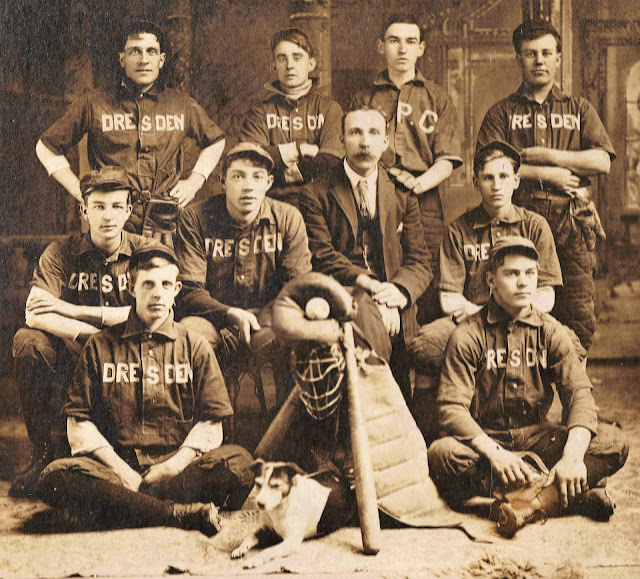
Wid Bedell as a Dresden
baseball player, circa 1920 |
In the 15 years that Wid sharpened my skates I can recall him increasing the price only once -- 25 cents to 35 cents. I honestly do not think that he provided the only sharpening service in town just to make money. More than anything, he enjoyed interaction with people coming into his shop, and generally "sports" were the topic of conversation.
At one point in the mid 1940s Wid joined my father Ken and Harvey Hoppins in organizing the first town baseball league for boys, approximately 12 to 14 years of age. The league was one of the first sponsorship projects for a relatively new Optimists Club. Wid coached the Central team, Harvey the North and Ken the South. A number of "exhibition" games were played against a team from nearby Rutherford, coached by Pat Johnston. There should be a special category in the Dresden Sports Hall of Fame for men like Wid, Harvey, Ken and Pat who took a special interest in the youth of the community before the advent of an organized minor sports movement.
...then there was Harry Lefebvre
.
Harry Lefebvre served the bicycle community in Dresden much the same as Wid did with his skate sharpening. There was never a bike invented that Harry could not fix. Kids would drop off their bikes at his north Dresden repair shop (garage) on their way to school in the morning and pick them up on their way home after 4 o`clock. Spokes and pedals replaced, chains relinked, sprockets and handlebars straightened, seats repaired, innertubes and tires patched -- Harry did it all, and more. Always with a grandfatherly smile.
--------------------------------------------------
(I remember, cont'd.)
-- Playing hockey on the "Gully" on the northern outskirts of town and the
Sydenham River.
-- Public skating in winter on the town's outdoor rink at the Market Square (Jackson's Park).
-- The newly-formed Optimists Club agreeing to sponsor the first bantam-age town hockey league for boys in 1948. The teams played games on the Market Square rink. Optimist Walter Holmes headed the boys hockey committe with Ford Newman serving as league convenor. Eugene Huff was in charge of "equipment and travel", although I don't recall much equipment or travel. A year later a town baseball league for bantam-aged players was formed under the auspices of the Optimists.
-- My dad and Harold Carr forming a kids hockey team to travel to Rutherford to play games on the frozen floor surface of Pat Johnson's chicken barn. (Practice rink was Carr's back yard in the pre-arena days.) Keith Babcock was our leading scorer. Pat complained because Keith "raised the puck" when shooting on goal. A sly old fox with a straight face, Pat was always full of 'em, and not to be taken seriously.
--Slugging wheelbarrows of gravel and spreading it over refrigeration pipes in order to have ice in the just completed new arena for the winter of 1953. No one was more proud of that first ice surface than arena manager Red Brewer. The floor was properly cemented before the start of the next skating season.
-- Attending Dresden Seniors baseball games at brand spanking new Kinsmen Park and cheering the play of Red Brewer, Fred Wicks, Roy Holmes, Gord Ball, Gerald Cook, George Bedell, Clare Mifflin, Norm Paddick, Hughie McCorkle, Maurice Smith, Clarence Horely and Bill Campion; manager Stan Wells. Shagging flies in the outfield as the above players took batting practice.
-- Being
batboy for the Dresden Juniors team that consisted of Walter McFadden Jr., Pat Myers, Len
Bedell, Gord White, Louie
Paluch, Alvie Lovell, Lyle Houston, Jerry Wicks, Don Clark and Hugh Fitzgerald; manager Walter McFadden Sr.
-- Coming up through bantam and midget baseball ranks and being a member of the Dresden Legionnaires team that won the Ontario Juvenile "C" championship in 1953. Inducted into the Dresden Sports Hall of Fame 50 years later.
-- Being named Lt. Col. of the
Lambton Kent District High School Cadet Corps. and taking part in annual inspections, then the highlight of the school year.
-- Performing(?) in high school Gilbert and Sullivan productions directed by music teacher Vaughn Ayers.
-- Attending worship services, Sunday School and Young Peoples at St. Andrew's Presbyterian Church.
-- Attending Anglican Church Young Peoples meetings as the guest of Donnie Brooker, Jim Blackburn, Bruce Huff and Larry
Medd.
-- Outdoor suppers at the United Church,
Shrove Tuesday pancakes at the Anglican Church and Robbie Burns Night haggis at the Presbyterian Church.
-- My dad
carrying the ceremonial haggis on his head on several occasions.
-- Attending Nov. 11 Remembrance Day Services at The Cenotaph and understanding the "supreme sacrifice" of so many young Canadians in two world wars.
-- Having at least three serious "crushes" but naturally too shy to let the objects of my affections in on the secret.
-- Hanging out with my friends and having milk shakes at Fitzgerald's Restaurant, later taken over by Reg Swainston..
-- Walking home after dark and appreciating the tranquility -- peace and quiet -- of the warm summer evening and somehow sensing that this would be a memory that would never leave me.
--Walking up Hughes Street with my mother on some of those summer evenings to join my Aunt Hattie (Sharpe) and cousins Jim and Norma on their front porch. We'd talk and laugh, many times till well after 11 o'clock. The Rigsbys, Hendersons, Tedfords and Morgans would often drop by. One day a fellow just back from the war, Bill Johnston, joined us -- and never left.
-- Buying a bottle of pop, generally Orange Crush, from
Ern Sharpe and playing the pinball machine (the only one in town) in his
Supertest gas station.
-- McKay's Cafe which became the gathering place for gents of the town after the Wescott House (mentioned in Ken's word picture) burned down. Coffee and lunch breaks were taken in the kitchen of the restaurant where owner Morley McKay and cooks Roy Turner and Fred Wicks held court. Many of the world's problems were solved (and a few created) in the "coffee club". Everyone had a nick name and gossip was always the order of the day.
-- My first part-time job at Don Weese Men's Wear at 14 years of age. Owner Don left me alone in the store 15 minutes after starting my first day on the job and believe it or not my first customer was high school principal Ed Logan who purchased a pair of Tooke boxer shorts for $1.65. I was mortified when Ed had to show me where the boxer shorts were kepted on the shelf and how to open the cash register. Talk about learning the hard way!
-- Being aware of and regretting certain racial discrimination in town, not fully understanding the history nor the implications at the time -- an unfortunate, one-and-only blemish on an otherwise strong, close-knit community; to which I can only comment: "Forgive them for they knew not what they did" and add words from my father's rhyme "...All are God's children..."
-- More recently, after the death of my mother at 92 years of age, having to sell the family home on
Sydenham Street built by my grandfather Wesley Wright in 1879.
-- The sound of gentle breezes blowing through lush green foliage of maple trees at the Dresden Cemetery as I cast my eyes to the blue heavens dotted with soft while billowy clouds and thanked God for those who had gone before -- and all that I
remembered.
So, there you have it. Random reflections of my home town, not always perfect, but darn near.
------------------------------------------
The remarkable story of a meteorite that landed on a Dresden area farm, July 11, 1939
 |
| Luke Smith (right) and farmer friend Marshall McFadden admire the Dresden meteorite resting between then on a porch step. Later that day, Smith persuaded the original finder, Dan Salomon, to sell him the space rock for a paltry $4.00. |
A spectacular fireball roared across the sky in southwestern Ontario as dusk fell on the night of July 11, 1939 and was seen by thousands of persons there and in Michigan, Ohio, Wisconsin, and even as far away as Pennsylvania. The fireball underwent three explosions, and ended up dropping a 40-kg (88.25 lbs.) meteorite in the sugar-beet field of Dan Solomon, about 10 km southwest of Dresden, as well as several small fragments in nearby fields.
The meteorite, known officially as the Dresden (ON) Meteorite was high in nickel and iron content with many other properties and classified as H6 Chondite. It remains the second largest individual meteorite to ever fall in Ontario and the fourth largest from all of Canada. Through an interesting route, it ended up at the University of Western Ontario (UWO) and was put on display in the Biology and Geology Building.
The first recovered fragment of the Dresden meteorite was a small piece reported to weigh about 1 lb (454 g) dug out of the ground by Bruce Cumming on his sugar-beet farm, about two km south of Solomon’s farm. Cumming reported (Chatham Daily News, July 12, 1939) that he and his family were attracted outdoors when the entire countryside was lit up by the glare of the falling meteor. He reported hearing a roar "like thunder" when it seemed to pass directly overhead, then "a strange noise like the staccato firing of a machine gun, or the sputtering of an airplane engine," and then a "dull thud", as the meteorite hit the ground about 100 metres from his house.
 |
This fragment of the Dresden
meteorite was found in a Grand
Bend flea market in 1993. |
The family quickly formed a search party, and headed out in the direction the noise seemed to have come from. Their dog Shep accompanied them and led them directly to the spot where the meteorite had landed and buried itself to the level of the dirt and mashed one or two small sugar beets to a pulp.
The main mass of the meteorite landed in Solomon’s field, only 200 metres from where his wife Hazel was standing with their children. Her description of the event clearly reveals how terrifying it was for her: "My little girl, two years old, saw it first, coming out of the northern sky. I was weeding in my garden at the time. When I first looked up it was about the size of a baseball. It kept getting bigger and bigger until it was about the size of a bushel basket. I started to run toward the field at the back of the house. I was too scared to know what I was doing. When it got directly over me it stopped and made a noise just like a big rotten egg being broken -- a sort of hollow plop. The thing shot off toward the west. Just at the same instant or maybe a second afterward, I heard a terrible noise in the field right ahead of me. It sounded like a big airplane tearing along the field. That scared me worse than ever and I turned and ran back toward the house. My four children were with me. My husband returned from Dresden a few minutes later, but I wouldn’t let him go to the field until the following morning."
 |
Dan Solomon up to his chest
in the meteorite hole. |
On the morning of July 12, Dan Solomon set to work to retrieve the main mass of the meteorite. He found that it had made a hole 30 cm by 45 cm. Dirt was piled up all around the hole and chunks of earth were thrown 13 metres away. He enlarged the hole and began digging. At about two metres, the top of the meteorite became visible. His children looked on with fascination, as did a crowd of interested neighbours, including Charles "Chuck" Ross, then a young editor of the Dresden News, who had raced to the scene. Ross helped Solomon hook a chain around the meteorite, and with neighbours’ help they were able to extricate it from its hole.
Later that day, Henry Lozon reported he had recovered a fragment weighing about 5 lbs (2270 g) 80 metres from his house, and it was rumoured that two other nearby neighbours, A.V. Scott and George Highgate, had also dug up fragments of the meteorite on their farms. According to a report in the Globe and Mail ( July 13, 1939), they "were awaiting offers" for their specimens.
Solomon didn’t have long to wait for an offer for his 88.25-lb (40.07-kg) meteorite. Luke Smith, a former Chatham dentist turned oil and gas prospector, and his friend Marshall McFadden, saw the meteorite as it was being cleaned and
quickly paid Solomon a visit. Smith decided (Toronto Daily Star, July 13, 1939) he wanted to purchase the meteorite: "I thought an oil man should not miss a chance to get that close to heaven. Besides, it’s a nice relic." According to one story, he was told that someone had already offered Solomon $3.00 for the "souvenir", so he raised the ante to $4.00.
 |
Beth Ross, sister of Dresden
newspaper editor Charles Ross,
in the process of cleaning the
Solomon farm meteorite. |
Solomon’s son Wilfred later said that Smith and McFadden pestered his dad incessantly to sell the meteorite. Solomon, by all accounts a very gentle, soft-spoken man, gave in to this pressure, and agreed to sell it to Smith for $4.00. But within a very short time, Solomon began to realize how terrible a deal he had made. A desperate plea to retrieve the prized specimen from Smith was to no avail, however.
Many in the area at the time protested that Smith had taken unfair advantage of Soloman, but he held fast claiming that a deal is a deal and
"the law of supply and demand held good, even for meteorites." He subsequently refused a number of offers to purchase (including universities in the U.S. and the Smithsonian Institution) in the $200.00 range, holding out for his price of $800.00 to $1,000.00.
Newspaper accounts about the meteorite appeared daily. So did hordes of motorists, some from as far away as Ohio, who lined the concession road in front of Solomon’s farm for days on end, eager to see the meteorite. Although they were disappointed to find out that it was no longer there, many helped themselves to small chips of the meteorite that had splattered off when it plowed into the ground, or had been rubbed off it by the chain used in its excavation. Wilfred Solomon remembers selling small chips to passing motorists for a few pennies each. Many of the tourists were from the U.S., prompting one newspaper (London Free Press, July 22, 1939) to wryly note:
"...American tourists have gone home with a large number of fragments from the recent spectacular meteor. This addition to Canada's tourist income will never be known, probably."
~~~~~~~~~~~~~~~~~~~~~~~~~~
On the lighter side: Dresden Virtual History Group contributor Frank Vink, recalls with humour that his father, whom he expected watched too many Flash Gordon movies, was sure that the meteorite was an invading "rocket from China". His grandmother even got her rosary out, convinced that it was "the end".
"A piece (of the meteorite) landed in the field of a neighbor on the Prince Albert Side Road in the 13th Concession of Chatham Township. When the neighbor retrieved the remnant, he put it into his flower garden," Frank adds.
~~~~~~~~~~~~~~~~~~~~~~~~~~
In early October, it was announced in the London Free Press, (Oct. 7, 1939) that the meteorite had "been purchased outright and now is in the possession of the University of Western Ontario." Although the price was not given, the newspaper article read: "The purchase of the famous fireball was made possible through the kind offices of the directors of the London Life Insurance Company."
Through the efforts of Don Spanner, the London Life Archivist, UWO author Howard Plotkin found out that its Board of Directors contributed $700.00 to the university to buy the meteorite from Smith. London Life's gift was motivated in large part by E.E. Reid, Managing Director, who was also a member of the University’s Board of Governors. Reid stipulated he wanted the meteorite displayed in the new observatory soon to be erected on the campus, a gift from the estate of actor Hume Cronyn. In 1970 the meteorite was moved from the Observatory (a plaster cast of it remained there), and placed in a glass showcase outside the office of the Department of Geology.
It was not until some 60 years later that members of the late Dan Solomon's family were honored by the University of Western Ontario for their father's historic discovery and the innocent, ill-advised deal that saw him give away the Dresden meteorite to the shrewd opportunist, Luke Smith. (See photo)
Siblings of Dan Solomon with UWO officials.
Dresden's greatest foul ball chaser
(Written with utmost respect and fondness)
Everybody in Dresden knew Dave McCracken in the 1940s and 50s. "Hi Dave!" could be heard from both sides of the street as he wheeled his bike through town. He was rarely seen without his high cuffed riding (work) gloves, baseball cap, a military badge or two pinned to his shirt and bicycle clips that kept his pant bottoms tightly in place around his ankles.
.
Dave lived in a harmless fantasy world. He loved anything military and he would talk convincingly about belonging to the Kent Regiment in Chatham. If you didn't know him you would swear that his stories were based on fact and not fiction. Words flowed from his mouth in rapid fire sucession, sometimes jokular and other times with raw emotion, revealing a mind that could be quite quick when it came to creating scenarios that I truly feel he himself believed. Guys back from army service, including my cousin Major Jack Sharp, would give him bits and pieces of their uniforms and Dave wore them with pride.
.
He loved parades and would always stand at attention, as if on a reviewing stand, as the marchers and bands passed by. On one occasion I was leading the Lambton Kent District High School Cadet Corps on parade through town following an annual inspection ceremony when I spotted a very erect Dave strategically positioned at the curb. Acting on impulse, I gave him an eyes right and a sharp salute to which he responded with an equally crisp salute and a "click" of the heels.
.
Good thing that teacher, cadet instructor Frank Brown and the inspecting officers did not see what had transpired or I would have been hauled up on the carpet for sure. But the look of pride and self-importance on Dave's face and the fact that I had unquestionably made his day, more than made up for the risk I took in breaking parade protocol.
.
He knew that he had a ready listener in me and he frequently dropped in to Weese Men's Wear, and later Bowen's Men's Wear, to regale me with stories about the army, his girl friend and working at O & W McVean -- all figments of his very active imagination.
.
Dave's other love was baseball games. He never missed one in town and was always the self-appointed "ball chaser". At the crack of a foul ball Dave was off at break-neck speed, legs pumping in Roadrunner fashion, to retrieve it. Kids a good 20-30 years his junior would sometimes try, unsuccessfully, to beat him to the ball and Dave would dive head first to grab the errant missle from their grasp. His speed afoot was amazing and I often thought that he could have been a good competitive sprinter.
.
One thing for sure, Dave certainly saved Dresden ball teams a lot of money in lost balls over the years.
.
Sadly, he developed problems with the lean, long legs that for several decades had carried him so speedily in pursuit of hundreds of foul balls at the Market Square and Kinsmen Park. He was admitted rather prematurely to a nursing home. He never did anyone any harm.
.
Wherever you are today Dave, I salute you -- once again!
-------------------------------------------------------------
Thanks to Harold, I Avoided My Mother's Broom
The Wright family, as far as I know, were always respectable, law-abiding citizens. As a young lad about to step out into the world to seek fame and fortune, I certainly had no intention of blemishing that fine record. An incident when I was about 16 years of age, however, still has me feeling like a borderline criminal -- thanks to my mother of all people.
On one fateful evening I had attended a movie, stopped for a customary milkshake at Swainstson's Grill and engaged in some small town banter with a few friends on the main street corner when I realized that it was getting rather late. I don't remember ever having an official curfew, I just always knew that it behoved me to be home somewhere between 10 and 10:30 on movie nights or suffer the wrath of my mother who could be quite excitable and reactionary at times, to put it mildly.
 |
| CONST. HAROLD HEDDEN |
Having lost all track of time, and before I knew it, the town post office Big Ben was striking 11 o'clock. "I'd better get going." I said to my friends as I broke away from the group.
I was only a couple of minutes into my walk home (opposite the Green residence and across the street from Doc Ruttle's, as I recall) when the town police cruiser slowly glided up and stopped beside me. "Are you on your way home, Dick?" came a voice from the darkened vehicle at the curb. Recognizing the form of Police Constable Harold Hedden, I responded in the affirmative.
"That's good," answered Harold, "because your mother just called and wanted us to pick you up."
Almost as an afterthought when pulling away, he applied the brakes and shouted back: "Better get a move on and good luck when you get home." I knew what he meant.
As I cautiously approached our property on Sydenham Street, I could see the shadow of a figure hovering just inside the front door. Having been there and experienced that on several occasions in the past, I pushed the door open and took a quick step backward. A corn broom came crashing down in front of me, breaking into three pieces as it hit the floor with great force. I made a hasty entry unscathed, leaving my mother with half a broom stick still in her hand and screaming: "Now, see what you made me do!"
Just some of the things that a boy has to endure when his mother is trying to raise her only child as best she can, and on her own, under less-than-desirable conditions in the 1950s.
I always thought kindly of good old Harold for his discretion that night and for giving me advance warning of the potential bodily harm awaiting me when I got home.
The police motto: "To serve and to protect," has special meaning for me to this day.
~~~~~~~~~~~~~~~~~~~~~~~~~~~~~~~
The Church Ladies: Fondly Remembered
I have fond memories of my early exposure to the wonderful work of "women of the church". Regardless of denomination, the faithfulness and commitment of women's organizations have, without question, been the life blood of all communities and their churches across our nation.
At a very early age, I came to realize what women of the church really stood for, be they auxiliaries, societies, ladies aid or missionary groups. The Imperial Order Daughters of the Empire (IODE) was an all-inclusive group in my hometown of Dresden, bringing together women from all churches, and continues as well to have a special place in my heart to this day.
In the early 1940s, I remember very clearly being relegated to my upstairs bedroom on evenings when my mother hosted church group meetings and gatherings of the IODE. I would curl up on the floor with my ear cupped to the metal grate that allowed warm air from downstairs to circulate to the unheated upper floor level. I would listen to what was transpiring in the parlour and living room below -- the prayers, God Save the Queen, hymns, committee reports, updates on care packages and those coarse woolen khaki socks and mitts so lovingly knit by the ladies for the troops ("our boys") overseas in World War Two. Of course, there would always be at least one fund-raising program on the agenda to help bolster organization and church coffers.
I was able to put a face to every voice that came up through that dusty grate and I was fascinated by what was being said and who was saying it: Several school teachers, the banker's wife, a nurse, my Aunt Hattie, several of my best friends' mothers, a druggist's wife, a farm lady who delivered eggs to us every Thursday, a choir leader with her unmistakable laugh, a minister's wife with her quiet voice of reason, occasionally my mother -- the collective face and voice of mission and outreach in churches and communities small and large, around the globe.
Looking back now, maybe I was hard-pressed for entertainment. Maybe I was just curious -- maybe a combination of the two. Remember that there were no televisions, i-pads, computers or cell phones in kids' bedrooms in those day. Certainly, it was a different era and I am glad that I was brought up in it. At that impressionable age I came to understand how the efforts of a small group of women in small-town Southwestern Ontario, could have such a far-reaching impact.
With the impression of the grate well embedded in my cheek, I would generally drift off to sleep just as tea cups began to tinkle amidst the soft din of female conversation at the conclusion of the business portion of the meetings. All was right with my world. I could depend that there would be leftover peanut butter cookies and at least one date square put aside for me next day, several of the ladies would always see to it. I was warm and secure. God was in Heaven and "The Church Lades" had everything under control.
Fond memories all, and an appreciation for the work that church women and organizations like the IODE have continued over the decades with much dedication and little fanfare. I dare say that there are no inquisitive little boys eavesdropping on meetings these days, but it goes without saying that God has an ear to His Heavenly "grate" and He blesses all church women for what He is hearing.
The two front doors to my "Home Sweet Home"
(From my Wrights Lane web site)
 |
| MY FAMILY HOME in Dresden from a water colour painting collection. Note the two front door entrances. Also one of the original front door keys, inset. |
I have been looking at some old photos of homes built in the 18th and 19th centuries. Many of them bear remarkable similarity to the Dresden home that I grew up in (built by grandfather Wesley Wright in 1879).
The homes had one particular, striking thing in common -- two front entrances. I have always wondered about the practicality of dual entrances, but given the formality and conditions of the era, it does make some sense.
The one front door, usually slightly recessed, opened into the "keeping room", where the family kept house. The area usually contained a large fireplace or wood-burning stove for cooking, a pantry, and of course table and chairs for regular family meals and relaxing. At the turn of the century, fire-burning fixtures were slowly replaced by gas-burning stoves in pantry areas that were expanded into full-fledged kitchens, completed by the advent of electrical refrigerators to replace the former ice boxes.
Family members and close friends were generally the only ones to use the keeping entrance. The other front door would lead into the living room or front parlor, which were generally used for special occasions. Our formal front entrance in Dresden opened into a small vestibule which led to a second floor stairway and the front parlor. Special guests and strangers just naturally gravitated to this door.
It was not uncommon too in those days that deceased family members would lay at rest in front parlors for visitors to pay their respects before removal for the actual funeral service itself and interment. The formal front entrance allowed for easy casket negotiation and placement with minimal disturbance for the family. In my case, two sets of grandparents and my father lay at rest in what we called our "front room". I always had an uncomfortable feeling about that and one of the reasons that I eventually sold the home -- too many memories, adolescent impressions, and ghosts from the past.
There was normally a wall between the two front doors which could, if necessary, be converted into two separate family living quarters. In our case, after my father passed away, the formal front door conveniently served as a natural private entrance for second-floor apartment renters.
It is interesting to note, too, that churches of the era also had two front entrances, one for men and the other for women. Men and women even sat on opposite sides of the sanctuary in earlier days. Schools were also built with separate front entrances, one for boys and one for girls. In the old Dresden Continuation School that I attended, separate entrances and playgrounds for grade school kids were at the back of the building. The one front main entrance was for high school students with the other for the exclusive use of teachers.
At one time. even hotels and so-called beverage rooms had separate entrances and accommodations for male and female patrons, but I am straying a bit off topic.
During and following the Great Depression, the location of our home on Sydenham Street seemed to attract the attention of transients (tamps, hobos, beggars) of the day. I remember in particular, one handout solicitation at our "keeping" door. It just happened to be at supper time on a hot summer evening and my mother, who always prepared more than enough food for one sitting, invited the bedraggled stranger to have a seat on our front porch. Within a few minutes she returned with a plate of roast beef, mashed potatoes, carrots and gravy with a slice of apple pie on the side and a glass of lemon aid with which to wash it all down.
In no time at all, our unexpected visitor was knocking on the door with the empty plates and utensils in hand. "Thank you very much Misses," he said. "That was as good as if I'd had a full course meal!"
From that time on, I never finished one of my mother's meals without repeating the hobo's left handed compliment.
Awe me -- the past...the thing of which memories are made.
An encounter with Gramma Carr's front porch railing
*Click text to enlarge image

The above "fun" item is taken from my book "Dresden Life Remembered".
The Wright home on Sydneham Street, before exterior renovations, circa 1935.
Renovations completed in 1945. Above photo taken in 1955.
-------------------------------------------.jpg)
A TRIBUTE TO SCOUTER GEORGE BROOKER
There are two or three individuals in the life of every young man who stand out as influential role models. One, of course, was my father Ken...The other was George Brooker, Mr. Scouting in the Town of Dresden for more than three decades.
The rotund George was the most jovial, easy going, sensitive man that it has been my pleasure to know. In business, George was a successful insurance man but in life he left his mark as the ultimate Scout Master, eternally imbedded in the minds of hundreds of young men who experienced Scouting in Dresden as Lord Baden Powell intended.
"I promise to do my best, to do my duty to God and the Queen...and to do a good turn to someone every day." That was not only the Scout Promise for George...He lived it, and he expected all of his Cubs and Scouts to live it too.
George had two sons and a daughter of his own but it did not seem to bother Gerald, Joan and Donnie that they had to share their dad with most of the other kids in Dresden. George never outwardly favored any of them when it came to Scout activities and I always admired that. I just felt that I too was a member of the Brooker Scouting family and I think that most other kids felt that way too.
Unrelated to Scouting, my dad and I saw our first televised National Hockey League game on a TV set in the Brooker home.
George had the assistance of Russ Medd, Les Hawgood, Gummer Spearman, Glen Wicks, my dad and others in the 1940s, but nothing could compare to the hundreds of hours he devoted each year to meetings, hiking, camping and bugle band practices alone. In all that time his cheerful demeanor never changed. It seemed as though he was a "rock" in every sense of the word.
I have at least a dozen George Brooker stories but I will relate only two here as reflective of the impact he had on me.
George never swore and had a unique way of expressing his emotions. "Good gravy", "great balls of fire" and "oh fudge" were just a few of his favorite expressions. Only once, in my experience, did he ever deviate from his Georgeisms.
It was the first or second year after moving the Cubs and Scouts camp from Walpole Island to a site on Lake Huron near Camlachie. George decided that he would transport the boys to camp enmass by means of a bus -- first the Scouts and then the Cubs who were told to be ready for departure at 8:00 a..m. After three hours of restless wait it was learned that George's bus had broken down just north of Oil Springs. A mechanic and wrecker were dispatched from Wilmott's Garage and finally a frustrated George, the Scouts and bus appeared on the scene at 2:00 o'clock. As he stepped from the bus, George was destinctly heard to utter the word "sh--". It was history in the making.
George apologized profusely to the Cubs who were now into their sixth hour of waiting. He told us to go home and to return at six o'clock in order for him to have the bus checked over thoroughly so that he could be assured that "no more stuff like that would happen again."
The Cubs, George and the "blasted" bus made it to camp by eight o'clock that evening, 12 hours after the originally scheduled departure time. It had been a long tiring day for the young Cubs -- even longer and more tiring for old George. I couldn't help but notice that Scouter George was noticeably and uncharacteristically quiet the next day. It was reported that he had a bad "headache".
Some time later, on the way home from school one day, I had a physical encounter with an older boy by the name of Bill Sayers. I can't recall the reason for disagreement, but Bill was obviously upset and challenged me to "put up my dukes". I accommodated him and the next thing I knew my fist made contact with his eye and it was fight over.
Just my luck that George had witnessed my fisticuff display from his car parked across the street. He came to Bill's aid and drove him to the doctor's office to have his eye looked after.
The next evening at our Cubs meeting, George announced to the Pack that I had won the "Cub of the Month Award" for some badge work that I had done, but because I had been in a fight the previous day I would be forfeiting the award and accompanying $5.00 prize. "Cubs and Scouts just do not fight," George emphasized. Needless to say, I was crushed and it may have shown.
A week later I happened to be walking past George's insurance office when he spotted me and called me in. As he leaned back in his revolving chair George gave out with one of his patented laughs that seemed to have its origin deep within his belly. "Boy, that was really a haymaker you landed on poor old Bill," he said reaching into his desk drawer and pulling out a handful of change. "Here this is for you," he added. "But no more fights!"
"Thank you," I replied, cupping the coins in two hands.
Outside, I sat on the curb and did a quick count of my windfall. George had given me $6.45. That was $1.45 more than I would have received with the "Cub of the Month Award".
George leads his Boy Scouts bugle band on parade through downtown Dresden, summer 1948.
--------------------------------------------
Clipping from the old scrapbook, 1946
*click photo to enlarge
----------------------------------------------------------------
A kid never forgets older guys who took an interest
 |
| Gerald (Cookie) Cook |
A little earlier on in my
"I Remember..." I mentioned spending a lot of time at games and practices of the Dresden senior baseball team. A number of the players seemed to take a special interest in me -- in particular
Roy Holmes, Gerald Cook and Red Brewer -- I guess because I was always around.
Roy called me "lefty" and never failed to have something to say to me. At one point when I was about 12, Roy asked me come out to Wabash where he had formed a team of young players about my age (Roy of course was a Wabash boy himself). It seems he needed a pitcher and was I ever honored to be asked. I felt like an big "import", coming those five miles from the metropolis of Dresden. Some of the players on that Wabash team included Charlie Jackson, Jim Boyle, Stewart Ross, Charles Liberty, Milan Bohon and Ed Gervais.
 |
| Roy (Holmesy) Holmes |
When I returned home in 1956 from a baseball school in Florida, Gerald (better known as Elmer, and sometimes Cookie) was the first to quiz me on my experience. When I explained that I had been asked to stay for a pro tryout but decided to come home because of my $22.00-a-week job, he could not contain himself. "If you still have a chance to sign, get your backside down there right away because if you don't you'll always regret it," he said. I respected his opinion because he was probably the best baseball player that Dresden ever produced. He had also passed up a similar opportunity a number of years before and he knew whereof he spoke. With Cookie's words echoing in my ears I made a long distance telephone call to Florida, packed my bags, kissed my mother goodbye, returned to the spring training camp and signed a contract within 48 hours of my arrival.
Red and Elmer played together at one time with the St. Thomas Elgins of the Senior Intercounty Baseball League and I ended up following in their footsteps a decade later. Red liked to exchange St. Thomas stories and always made me feel like I was a better ball player than I really was. I looked forward to his knowing smile and the sincerity of his interest.
A junior lacrosse team was formed in Dresden in the early 1950s and, as with baseball, I was always around for games and practices at a makeshift field in Kinsmen Park (later to become the home of the Dresden Lawn Bowling Club). The coach and organizer of the team was Earl Garnet a veteran of Lambton-Kent-Essex lacrosse wars. One of the players, Bruce Huff, reminds me that the team was called Dresden Golden Angels and how badly they got "creamed" in their first game against a more experienced Wallaceburg club.
Some of the other players on the team were Bud Talbot, Ed Yott, John and Jim London, Jarvis Cook, Keith Babcock and Bob Davis.
I was too young at the time to play for the team but Earl for some reason took an interest in me. He even went so far as to give me a lacrosse stick and ball with the firm suggestion that I do some practising. He obviously saw potential for a future player recruit and kept checking on my progress. Our garage door took a real beating over the course of the next year, but Earl's team folded and I never got a chance to pay him back by playing for him.
A kid never forgets the older guys who paid attention to him when he was growing up. I always rembered that when, in later years, I became involved in minor sports.
Roy, Gerald, Red and Earl were more than just players and coaches, they were role models and goodwill ambassadors for the games they played. I am not sure the breed exists in small town sports today.
NEW...Remembering Rutherford's Pat Johnston, a sport for all seasons
By now it must be perfectly obvious that as a young lad growing up in a small town, I had great admiration and appreciation for the men who lent themselves to the development of young people, particularly when it came to sports. I have previously talked about my father Ken, Wid Bedell and Harvey Hoppins who were instrumental in starting up the first boys baseball league in Dresden in the 1940s. I have also referred in passing to Roy Holmes in neighbouring Wabash, Jack Martin in Turnerville and Garnet Elgie in Dawn Valley, all of whom worked tirelessly to organize baseball for their sons and friends in respective rural communities. With the exception of Jack Martin and Roy Holmes who were named to the Dresden Sports Hall of Fame some years ago, these men flew under the recognition radar and they would undoubtedly have it no other way.
 |
| Pat Johnston in his playing days |
I have always felt that Pat Johnston, an amicable Rutherford area farmer, was perhaps most deserving of more recognition for his involvement in community sports. Pat spoke with a slow drawl and wit that was typical of the entire Johnston family. You just never knew when he was pulling your leg or spinning a yarn.
Rutherford fielded boy's and men's baseball teams in the 1940s, all under the guidance of Pat who played a good brand of baseball in his younger days with the Dresden Mirwin Intermediates. The baseball field, worked primarily by Pat himself, was located behind what was then Shaeffer's Garage and Variety Store in Rutherford. Pat's youth teams played primarily exhibition games against neighboring communities including a bantam team from Dresden coached by my dad, but his junior and intermediate teams played in leagues against formidable opposition from Oil Springs, Wyoming, Petrolia and Wilksport, as I recall. I never knew any of his teams to have an official sponsor, other than guess who(?).
I think that I best remember Pat for his famous chicken barn cum skating arena. He flooded the floor of his barn in winter and hosted public skating and hockey games. Boys pick-up teams organized by Pat and my dad were great rivals for several years in that old barn which to us was every bit as good as Maple Leaf Gardens or Detroit Olympia.
Pat protested one of our hockey games because Keith Babcock, hands down the best Dresden player, had "raised" the puck on several of his 10 goals. He also protested one of our baseball games, contending that I was an illegal player because I was "under age". It so happened that I was 12 years old playing on a bantam-age team of players 14 to 16. The only way you could tell that he was kidding was to watch carefully for the twinkle in his eye.
My dad thoroughly enjoyed his friendship with Pat over the years, often referring to him as "salt of the earth with a heart of gold." Both of those guys are front and centre in my personal Hall of Fame and there are undoubtedly dozens of other "old young bucks" like me who feel the same way.
*CLICK *THIS SITE to view "Growing up with the Martins"
~~~~~~~~~~~~~~~~~~~~~~
An uncle who passed the "buck"
 |
Uncle Charles married into the family and owned a telephone company in California. My mother was so insulted by the $1.00 token (even in those days) that she never did spend it. It remains in mint condition. I'm still waiting for that "worthwhile" present from good old Charles...Guess I should not hold my breath. My mother would roll over in her grave if I ever cashed in the bill.
|
Young man about town...----------------k
Me standing in front of Bowens Mens Wear Store in 1954.
Crest for the new Lambton Kent District High School 1952.
.
*See more photos, reminiscent of life in Dresden, continued below.
**If you have any time left later, you might also be interested in this Wrights Lane post:
*CLICK DRESDEN NATIVE SKATE INNOVATOR